Showing posts with label breads. Show all posts

Saturday, March 11, 2006

Communion Bread


I've dallied over this post for weeks now, adding a little now and then but mostly leaving it to sit for days on end as a draft. It's long past time to send it on its way, so off you go little post!

Part of my reluctance has been due to some uncertainty that this would be of interest to anyone. Maybe it won't... but when I look at the question the other way... would I be interested in a post on this subject or, more broadly, on the subject of religious traditions involving food, I am confident in the answer - yes! The other cause for delay was that I hoped to include some historical background, but had some difficulty coming up with much of anything.

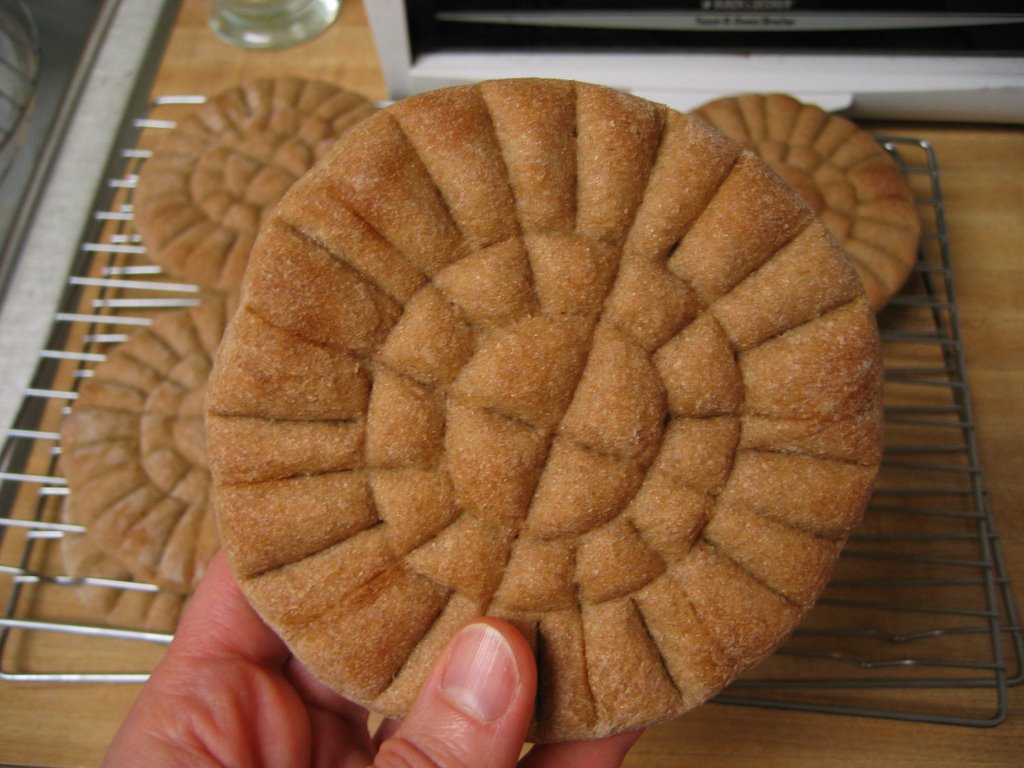
Every two months or so it is my turn to bake communion bread for my church. It's a simple recipe for unleavened bread consisting of just whole wheat flour, all-purpose flour, and water. The ingredients are stirred together, kneaded, and then allowed to rest for a few minutes. They are then shaped, cut and baked.


My tools are simple: a couple of biscuit cutters and a bench scraper. The first time I made the bread (which was a number of years back), I didn't have a biscuit cutter that was the appropriate size for the inner-most circular cut. As I so often do, I had left the bread-making until the last possible moment, so I had to quickly improvise. I had a plastic coffee measure that was the right size, so I hacked at the handle with some scissors, pulled and twisted it until it finally came off. I tried my new cutter and it cut beautifully, the only problem was it created such a suction that it was difficult to pull away from the dough. I again dipped into my kitchen toolbox and found a sharp, two-pronged fork which I plunged (with some difficulty) into the closed end of my cutter creating some "breathing holes". Problem solved! My trusty little green cutter served me well for many years and even though it is now retired, I can't bear to throw it away.
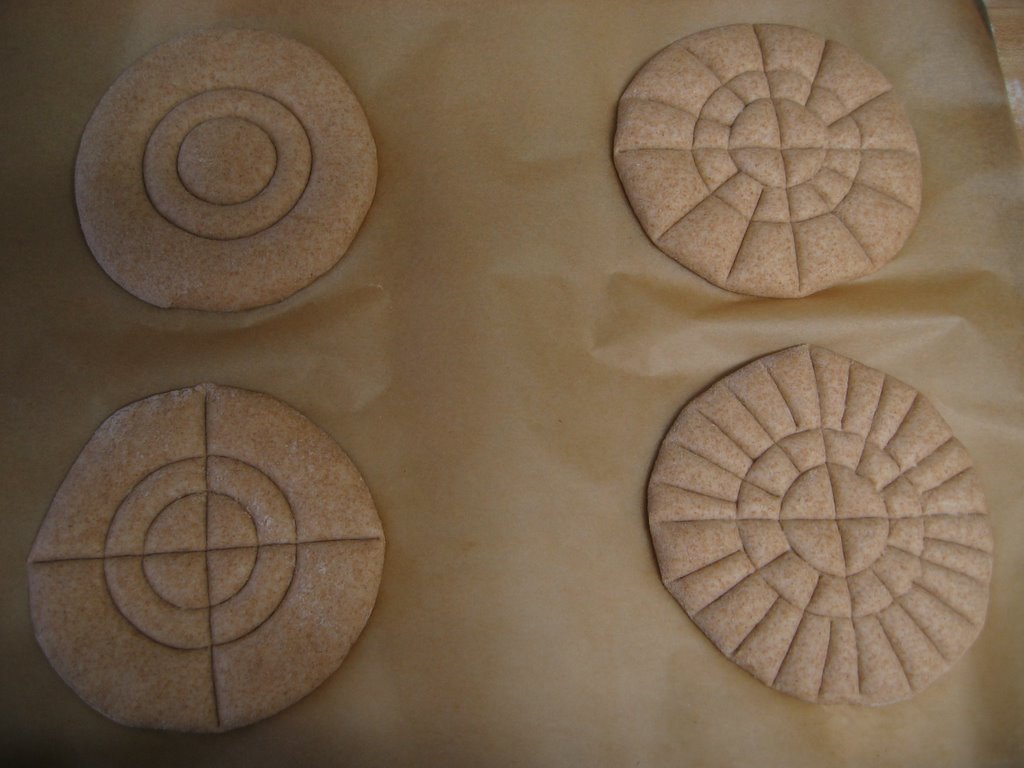


The recipe makes eight loaves and each loaf is cut into forty pieces. Most of the time while I'm making the bread, I don't really think about its significance, but when I come to cutting it, particularly when I make the two long cuts - like a cross - I will silently give it a little blessing.

The baked bread has a nutty sweetness that is very good. Of course, I've never eaten more than one small piece at a time.

When I was very young, the only type of communion "bread" I knew were those thin white wafers. At some point (the mid seventies?), homemade communion bread similar to that above was used on occasion. At the church a attend these days, the homemade bread is used routinely and those little white wafers are used only when and if the bread runs out. Anyway, I was wondering how it came to be that those wafers were used for communion. I'm not sure there is a definitive answer to that question. This fascinating history of wafers and waffles says that "The introduction of the ritual wafer into the West cannot be accurately dated, although in the form taken over by Christians, it may have arrived in connection with the cult of Osiris once found throughout the Roman Empire." The other interesting fact I was previously unaware of, is that the eastern Christian church uses leavened bread for communion, apparently believing it to be symbolic of Christ's resurrection.

So that's my story... and guess what? It's taken me so long to write this, that it's my turn to make bread again next week!


Update: I've had several requests for the recipe, so here it is...

Communion Bread

4 1/2 cups whole wheat flour (540g)
1 1/3 cups all purpose flour (170g)
2 1/4 cups warm water

Preheat the oven to 450 F.

Mix flours together, then add water all at once. Stir until flour is moistened and begins to "clean" the sides of the bowl. When I make the bread I find there's still quite a bit of flour that is not incorporated into the dough at this stage - that's fine. Dump the whole mess out onto the counter or a board and begin kneading. Knead for 5 minutes or until smooth - you may need to add a little flour as you go if it becomes sticky (use whole wheat flour). When done kneading, cover the dough and let it rest for 5 minutes (I just leave it on the counter and turn the bowl upside down to cover it).

Divide the dough into 8 parts (I find a kitchen scale is very helpful here). Roll each piece into a ball then press into a circle about half an inch thick (it should be about 3 1/4 inches in diameter). Score each loaf into 40 pieces (see the photos above) - cut the smallest circle first, then the larger circle, then cut two straight lines at right angles all the way across the circle, then cut each quarter of the two outer circles into thirds (two cuts in each quarter), then cut each section in the outermost circle in two. When making cuts, cut all the way through or nearly so.

Place loaves on cookie sheets lined with parchment or lightly oiled. Bake bread for 15 to 18 minutes until the center is firm and loaf sounds hollow when tapped on the bottom. Cool on a rack.

Thursday, October 27, 2005

Prune Blogging Thursday - Prune Bread


Yes, that's right - didn't you see the announcement? I couldn't resist participating (even if I am a little late)... such an unfairly maligned little fruit. This one time event was proposed by David Lebovitz and believe it or not, he's already written the round-up. I hesitated to post my homely little entry after seeing David's heroic efforts making chocolate macarons with prune filling (7 batches!), but I must show my support for the prune - however humbly...

I've always liked prunes, but I've never been crazy about prune juice. When I was a kid, my Mom often served a mixture of orange and prune juice at breakfast. I'm not sure if the reason was economy, nutrition, or just plain preference. Since I favored unadulterated orange juice, I always assumed that the orange juice was the scarce commodity and prune juice was her way of stretching it out. These days, with orange essence prunes in every grocery store, I'm thinking maybe she was ahead of her time.

I don't know the origin of this recipe, which uses both prunes and prune juice, but it is one my Mom grew up with. I've turned the tables on her, and have swapped orange juice for some of the prune juice. I also threw in a little orange zest for good measure. With whole wheat flour and prunes, there can be no doubt about the motives behind this recipe!


Prune Bread

The texture of this loaf is surprisingly light for a whole grain bread and the orange really is a nice complement. If I remember right, I believe we sometimes had this with baked beans rather than brown bread.

1 cup pitted prunes (I used bite size and left them whole, but it might be better to cut them up)
1/2 cup prune juice
1/2 cup orange juice
1 tbs butter
1 egg, beaten slightly
1 cup sugar
2 cups whole wheat flour
1 tsp baking soda
1 1/2 tsp baking powder
1/4 tsp salt
zest from one orange

Warm the juices and butter together until the butter melts. Put the prunes and juice mixture in a mixing bowl. Add egg and sugar. Add dry ingredients and orange zest. Bake in greased loaf tin for one hour at 350 F.

Thursday, August 05, 2004

It’s a Loaf!


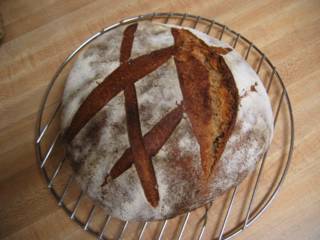
I had thought I would be writing this post last night, but I was up until one in the morning waiting for my first sourdough loaf to come out of the oven. When it did, I put it on a rack and fell into bed. I cut into it this morning with low expectations. It is a dense, sodden lump within a chewy crust and is barely edible. Yet, I am inexplicably optimistic that next time it will be better.

I should explain that I am currently “on vacation”. I am off from work most of this week and Monday of next week, but I have no plans to travel. Instead, I am puttering around the house with different projects (including the sourdough) and just enjoying a slower pace.

Yesterday was Day 5 for my sourdough starter. It was bubbling, but not very vigorously. On Day 5 my instructions said I should discard half of the starter and feed the remaining part with ½ cup of water and 1 cup of flour. I took 1 cup of the discarded starter and added flour and water to form a sponge for my sourdough loaf. The sponge was to proof for at least 8 hours or overnight. Unfortunately, I hadn’t planned well. In fact, I couldn’t have picked a worse time to start. It was about 10:30 in the morning and I had a feeling it was going to be a late night.

There was no guidance in the recipe about how to judge when the sponge is ready. Mine had some surface bubbles, but I’m not sure how much it had increased in volume. After dinner, I decided it was now or never, so I added the salt and the rest of the flour, kneaded it, and put it in an oiled bowl for the first rising. It was supposed to double in volume, but I’m pretty sure mine didn’t. I gave it an hour and a half and then pressed the air out of it, shaped it into a round loaf, and put it into a basket lined with a floured kitchen towel. I think the second rising may have been less successful than the first. Again, I gave it about an hour and a half, but it was after midnight and I could barely keep my eyes open, so I wasn’t waiting any longer.

I did have one small triumph in this whole process – I successfully transferred the uncooked loaf from the peel to the baking stone. My earlier attempt at doing this was a disaster. This time I used coarsely ground corn meal (polenta) on the peel and the bread slid right onto the stone. It probably helped that it was a small, dense loaf.

I toasted a slice of the bread this morning for breakfast. It has that distinctive sourdough taste, but it is just too heavy and dense. I am hoping that the starter will strengthen over the next couple of weeks, so that when I try again it will be a little more vigorous. Also, I know now that I should start in the evening so that the sponge can proof overnight. I measured my loaf (eighteen inches around) so I will be able to gauge the relative success of my next loaf. Hopefully, more time, a stronger starter, and a little experience under my belt will result in a better loaf.