Showing posts with label new for me. Show all posts

Sunday, February 05, 2006

I'm Frying! I'm Frying!


My to-do list for this weekend started with "Deep-fat fry". I've been putting this off my whole life, but I decided this would be the weekend I would finally put a check-mark in that box.

First, I must apologize to Bob and Chuck - they gave me a deep-fat fryer for my birthday last summer. (They presented it to me in Vermont, so it stayed up there until it could hitch a ride south with David in November.) I had planned to use it this weekend, but when I was setting it up I realized that it required a minimum of three quarts of oil to operate. I had less than two on hand and that amount of oil seemed excessive for this small project, so I decided to use a saucepan on the stove (and a little less than a quart of oil).

A little background before we get to the frying... I was the lucky winner of Nupur's chai hamper (her offering for A Menu for Hope II) back in January. My prize hamper included not only the makings for some wonderful chai, but some sweet and savory snacks to accompany it. The cookies and bhadang are but a memory now, but they were both fantastic. I've since made more bhadang myself (so easy!) and I think I've gotten Phil hooked on it too. Nupur also included some Pakoda mix in the hamper - a mixture of chickpea flour (besan) and spices which when blended with a little water forms the perfect batter for various kinds of vegetable fritters.

My first frying project was Onion bhajiyas using the Pakoda mix and recipe that Nupur had sent (which is a little different than the recipe linked to). Since I wouldn't be using the deep-fat fryer and had no experience frying, my candy thermometer (which is also intended as a frying thermometer) was very helpful in keeping the temperature in the desired range. It was my security blanket.

I may have been a little conservative on the temperature. I was aiming for around 325 F, but while frying it varied between 300 F and 340 F (or so). Lower temperatures cause the food to absorb more oil, but higher temperatures may not allow the insides to cook before the outside is overdone. Right now these decisions leave me scratching my head. I believe (hope) that experience will make them second nature.

Happily, none of my long-held fears associated with deep-fat frying came to pass. Both I and my kitchen survived unscathed. There was no fire, no smoke, and not even much of a mess. In fact, there was less of a mess than I've had with stir-frying because there was no spitting or splattering outside the pan. It actually seemed very controlled the whole time.

My only remaining concerns with deep-fat frying are 1) the cost of the oil; and 2) how to dispose of the oil. I filtered the oil and put in the refrigerator, but haven't decided if I will reuse it. Since I was cooking just two fritters at a time, I had the oil heated for an extended period of time and it may not be suitable for reuse. The problem is, I don't have a container at the moment that I'm willing to toss out with the oil. I'll have to start saving containers with this in mind.

I've rattled on long enough about frying, now about those onion bhajiyas... they were delicious! I've put some in the refrigerator and some in the freezer and will try reheating them in the oven. Now that I have privately conquered my deep-fat frying demons, I think I'll try making these for company so leftovers won't be an issue.

Thanks again to Nupur for the Pakoda mix and the rest of the great chai hamper she put together. Thanks too to Bob, Chuck, and Nupur for giving me the little push I needed to finally get frying!

Finally, I have to show you the cutest onion bhajiya you ever saw. I found as I was making these that they were sort of like ink blots or clouds, in that the shape would sometimes look like a familiar creature. I know what this one is - do you?

Sunday, July 24, 2005

A Second Helping of Indian Home Cooking


Tonight I prepared two dishes from Suvir Saran's Indian Home Cooking: Ground Beef with Spinach and Fresh Mint (Hara Keema) and Cucumber Raita (Kheere Ka Raita).

I especially enjoyed the Raita and found that it was quite easy to prepare. I used nonfat Greek Yogurt which has a wonderfully creamy consistency that I hadn't thought possible in a nonfat yogurt. The sizing of the yogurt was a bit of a puzzle to me, though. The 500g container claimed to have 3 1/2 cups in it. I needed 2 1/4 cups for this recipe, but when I measured the yogurt using a measuring cup, I found that I actually had only 2 cups or so.

I had a little trouble with the Ground Beef and Spinach recipe. It instructs you to bring 2 inches of water to a boil in a large saucepan. Ordinarily I wouldn't think twice about that type of vague directive in a recipe, but in this recipe a subsequent step calls for you to puree the spinach in a blender "with any remaining water". I agonized over this for a while and finally decided to put just one inch of water in my 3-quart saucepan. When it was time to puree the spinach, I had serious misgivings about putting all that water into the blender. I should have followed my gut and put the spinach and just a little of the water in the blender. But no, I had to slavishly follow the recipe. So instead of a green paste I had a watery green soup. The recipe says to add the green paste to the beef mixture and simmer for 5 minutes. Since I was adding green soup instead of green paste, it was clear I would have to cook it much longer in order to cook off all that water. I'm not sure how long I actually did cook it, but it was more than half an hour and maybe as much as an hour. The end product was still a little watery, but it was well after 10:00 and I needed to eat!

I enjoyed the dish, but not as much as the corn curry I made last week. I wonder if the long cooking affected the flavors of the dish. It was spicy hot, but the more subtly flavored spices weren't very noticeable - though I did get a blast of cardamom when I bit into a pod! I would think that long cooking of the greens in the green paste - spinach, cilantro, and mint - might have killed their bright fresh taste. Ah well, at least I know how to fix it next time!

Sunday, July 17, 2005

Finally!


"My Sister's Favorite Corn Curry" - from Indian Home Cooking

I love Indian food and have managed to accumulate several cookbooks on the subject over the last couple of years. I've poured through them many times and imagined what all those great looking dishes might taste like. But for some reason, I've always been a little overwhelmed by the lists of ingredients and what appeared to be fairly complicated recipes. I kept putting off actually trying one.

I got a little nudge a couple weeks ago when I saw Suvir Saran, author of Indian Home Cooking, at the Smithsonian Folklife Festival. I came home inspired and pulled out his cookbook to peruse yet again. Then last weekend, as I have before, I selected a recipe (this time a corn curry), purchased the necessary ingredients, and even made a trip to an Indian grocery to get a few things. But I didn't make it.

Tonight, with corn, curry leaves and a chile pepper growing old in my refrigerator, I knew it was now or never. I figured I had nothing to lose (except possibly an hour or so), but I wasn't even sure the corn would be any good.

In spite of everything - my week-old grocery store corn, not enough corn (once I had cut the corn from the cobs I had only 3 of the 4 cups needed for the recipe), and a whole wheat tortilla instead of a chapati on the side - the curry was wonderful. It had a rich creamy base and layers and layers of flavor.

I've picked out another recipe... maybe next weekend?

Monday, September 27, 2004

Halfway to Liking Shrimp


Shrimp Fra Diavolo

I do believe I’ve reached a milestone of sorts. If, as Jeffrey Steingarten claims, you can rid yourself of a food phobia by eating it eight to ten times at moderate intervals, then I am halfway to liking shrimp.

I made Shrimp Fra Diavolo with Spaghetti from Italian Classics this weekend. This time I used frozen peeled and deveined shrimp from Whole Foods. That is definitely the way to go – they smelled so much better than the “fresh” shrimp I bought from another store last month. Actually, they didn’t smell at all – which is as it should be. It was also nice not to have to peel and devein them. I thawed the bag overnight in the refrigerator, pulled their little tails off, rinsed them, dried them, and they were ready to go.

After my last experience with shrimp, I felt that I needed something bolder and spicier to mask the flavor of the shrimp, so I picked a recipe with copious amounts of garlic and hot pepper flakes, not to mention wine and cognac. However, the fact that the shrimp were in better condition this time was probably a bigger factor than all that garlic and hot pepper in making the shrimp more palatable.

When I first selected the recipe, I failed to notice that it called for flambéing the shrimp. I have never flambéed anything before and was a little reluctant to attempt it. I’ve always thought of the process as being mostly for show and not worth trying at home (though fun to see in a restaurant), but the recipe had a note which made me rethink my position: “Flambéing the shrimp in cognac brings out its sweetness and provides a nice balance to the spicy, garlicky tomato sauce.”

The shrimp are cooked quickly in a frying pan over high heat, doused with cognac, and then flambéed. That’s the plan anyway. My fear before starting was that I would have an out-of-control open flame that would burn me and/or my kitchen. What actually happened was that I couldn’t get the damn thing lit. I suspect that my pan, which was cast iron, was so hot that the alcohol cooked off before I even attempted to light it. The recipe had said to add the cognac and then wait a few seconds for it to “warm”, but I think the cognac was hot the moment it hit the pan – it steamed up like crazy. If anyone has had experience flambéing or knows how flambéing affects flavor, I’d be very interested to hear about it.

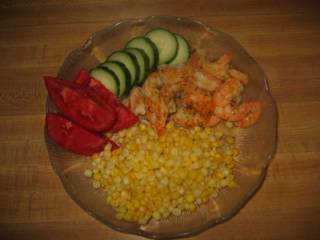
With all the excitement in the kitchen, I completely forgot to take pictures until after I had eaten dinner. So the picture above is of the leftover shrimp and sauce still in the pan and without the spaghetti.

Given that I am not yet a full-fledged shrimp fan, I enjoyed this dish quite a bit. I had some leftovers tonight for dinner and was happy to find that reheating shrimp in the microwave seems to work just fine.

Five more shrimp meals to go. Any suggestions?

Sunday, August 29, 2004

A Funny Thing Happened…


I was trying to find Gulf shrimp yesterday and had to visit several grocery stores before I was successful. In the morning, before I had begun my quest, I stopped in at my regular grocery store to get a couple of things. It was apparent after I entered the store that the power had gone out. While this particular grocery store is equipped to remain open when there is a power outage, the low lighting was a give-away that something was amiss. Later in the afternoon when I set out in search of Gulf shrimp, I decided to avoid that store because of the power situation. I went to a nearby Whole Foods, but as I started to get out my car an employee who was sitting outside called out to me that the store was closed. They were not set up to continue operations without power and in fact had resorted to moving all the meat onto a refrigerated truck. I drove over to another Whole Foods store but they didn’t have Gulf shrimp. Next stop was a gourmet store about fifteen miles from my house. I parked, and entered the store. That is, I entered through the first automatic door, but the next door did not open for me. Then I noticed it was dark inside. Would you believe the power had gone out at just the moment I was entering the store? Thankfully, it turned out not to be the east coast blackout that I feared and I finally did find some Gulf shrimp.

So why did I want Gulf shrimp? Well, let me back up a little. As you may know if you’ve read some of my earlier posts, seafood is not something I usually eat. My comfort zone for seafood is pretty much limited to canned tuna. I’m currently reading Jeffrey Steingarten’s The Man Who Ate Everything and am intrigued by his notion that you can rid yourself of a food aversion by eating the food eight to ten times at moderate intervals. I decided to start with shrimp, which strikes me as a lesser evil when it comes to seafood.

I dragged out a number of my cookbooks to read up on how to buy and prepare shrimp and to find a recipe that sounded appealing. I learned that most shrimp is either frozen or has been frozen, so chances are when you see something called fresh, it isn't really. I also learned that the preferred varieties were from the Gulf of Mexico. So, as recounted above, I decided to look for Gulf shrimp. I think next time I will buy whatever kind Whole Foods has. I did finally find Gulf shrimp, but I’m pretty sure it was not as fresh as it ought to have been.

The recipe I settled on was a very simple one from Mark Bittman’s How to Cook Everything. The shrimp were roasted in a hot oven with olive oil, rosemary, freshly-squeezed orange juice and some orange zest. I was encouraged by the aroma from the oven as they cooked – it smelled pretty good. Actaully, for a first try at eating a food I don’t like, it went well – I ate the full portion that I had served myself. The shrimp were subtly flavored with orange and rosemary, but I think I would have preferred something bolder. Next time I plan to try Shrimp Fra Diavolo with Linguine, which, with tomatoes, wine, and lots of hot pepper, should fit the bill.


Friday, August 27, 2004

Strike two!


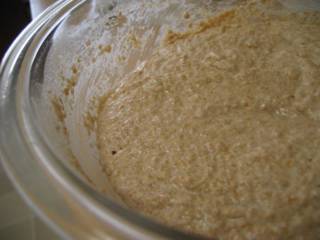
sourdough sponge

I tried to make sourdough bread again last weekend. I had better luck with the sponge this time, but that was it for the good news. I repeated a mistake from last time – I started too early in the day. I did it without thinking, but then I decided that I would just let the sponge rise for a really long time (the recipe says to let the sponge rise for at least 8 hours or overnight). I got started somewhere between 10 and 11 in the morning. I checked my sponge before going to bed and it was really bubbly. I was very optimistic at that point – this was much different than last time.

In the morning I found that the sponge was still very bubbly, but that it had deflated somewhat from the previous night. The picture above was taken after I had stirred the sponge down, but even then it was bubbly.

It was downhill from there. I added more flour and some salt to make the dough and then left the dough to rise. The first rise was supposed to take an hour or an hour and a half, but I left it quite a bit longer. I checked it from time to time but there was little progress. At some point I decided to go ahead and shape the loaf and start the second rise. I tried putting it in a slightly warm oven, but it did nothing. I let it go for several hours, but there was no sign of life. I decided not to bother with baking it.

I’m going to give it one more shot – I’ll let the sponge rise for 12 hours or so and see how it does. I’m also tempted to try it without the salt. After that, unless I get a decent loaf of bread, I think I’ll be tossing the starter – either that or start charging it room and board.

Wednesday, August 25, 2004

Any Ideas?


I tried something new the other day, but can’t say I was especially taken with it. Jicama was on sale in the grocery store and looked pretty good (well, as good as a big brown lump can look), so I decided to buy one. I’d had it in the refrigerator over a week before I finally got around to using it. At that point it had started to develop some serious pock marks, so time was running out.

Coincidentally, I had some jicama served to me in a salad Friday evening. Until then I had thought that I had never eaten jicama before, but now I would say it’s very likely that I've had it in a salad before. On Friday, I saw it on my plate and thought it might be jicama but had to check with the waitress to be sure. If you’ve never had it, it’s a wet crunchy vegetable. Someone I work with described it as a “radish with no flavor”, which is a fairly apt description. Anyway, the salad with jicama reminded me that I had one sitting in my refrigerator that needed to be used.

I had spent a little time looking around on the internet for recipes, but had not yet found anything that really grabbed me. I recalled that there had been a sign in the grocery store that said jicama was traditionally eaten with lime and chile. I had both of these on hand and was in a hurry to dispense with my jicama, so it appeared I had myself a recipe.

I decided I would shred or julienne the jicama on my fearsome mandoline. My brother originally bought this mandoline for himself, but was a little afraid of it and never got around to using it. He gave it to me, but I was a little afraid of it and never got around to using it. Finally, when he was staying with me and we were cooking together we used it. You should have seen us reading and re-reading the instructions and tip-toeing around that thing. We finally got it set up and made some wonderful potato galettes with impossibly thin slices of potato.


the underbelly of the mandoline...eeek!

But I digress. So... I got some much needed practice with my mandoline and shredded a bowlful of jicama. I then whizzed together the jalapeno pepper with the juice from the lime in a mini food processor and tossed that with the shredded jicama.

It was OK…but no more than OK. In case I’m ever moved to buy another jicama, do you have a favorite recipe for it?

Saturday, August 14, 2004

Making Tortilla Masa

Have you ever started a recipe not quite sure your skills and/or your patience would be up to the task? When I started making this tortilla masa last night, I was thinking the project could easily turn out to be a disaster. Actually, as I write this I’m thinking it may be a bit premature to declare a victory.

My molino arrived earlier in the week. You may recall that I had planned to make tortilla masa earlier, but then realized that I was not equipped to grind the corn. I ordered a molino – a corn grinder – from GourmetSleuth.com, hoping that it would do the trick. I’m still not entirely convinced that it is the appropriate device to grind corn for tortilla masa. My guide for this endeavor, Diana Kennedy’s From My Mexican Kitchen: Techniques and Ingredients, characterizes the molino as something used to grind a dryish masa for certain types of tamales. I’m not making tamales. Anyway, I plunged in last night and hoped for the best.


dried corn

The first few steps were easy enough. I weighed out two pounds of dried corn, picked it over, rinsed it, and then put it in a stainless steel pot and covered it with water. After the water came to a boil I added a little slaked lime (calcium oxide) and cooked the mixture for about 15 minutes. When the lime is added, the corn turns a deep golden color. The corn should be cooked just until the skins slide off easily. After about 12 minutes I tested a piece and found that I could peel the skin off, but I wouldn’t go so far as to say that it slid off easily. I let the corn cook another couple of minutes and then took it off the heat, since 15 minutes was the recommended cooking time and I feared I might overcook it. I then left the corn, which at this stage is called nixtamal, to soak overnight.


nixtamal that has soaked overnight

This morning I checked on the corn and found that the skins had not just loosened up, they had turned to slime. Removing them turned out to be much easier than I had anticipated. I started out rubbing the corn kernels with my fingertips under running water, but I had slippery kernels skittering off in all directions. I finally found a method that worked for me – I took a small handful at a time and rubbed them between the palms of my hands under running water. Doing this over the colander that held the rest of the corn prevented the escape of any wayward kernels. After the skins are rubbed off the corn is referred to as nixtamalizado and is ready for grinding.


nixtamalizado

Unfortunately, I do not have a work surface in my kitchen that I can clamp the molino to. There is not enough of an overhang on my counter, and my kitchen table is made of soft pine. Fortunately, I do have a suitable table in the basement. I cleared it off and cleaned it up, clamped the molino to it, and started grinding. I had been afraid that this stage might be tough-going, but it wasn’t bad. Of course, it’s possible I didn’t have the grinding plates as tight as they should have been! It took somewhere between 20 and 30 minutes to grind all the corn.


the molino with the nixtamalizado in the hopper and the finished tortilla masa in the dish

I plan to use some of the tortilla masa this evening to make Gorditas and will freeze the rest. Was the masa properly ground? Will the gorditas fall apart in the pan? Will they taste good? Was all this worth it? Stay tuned…

Saturday, August 07, 2004

Making Macaroni


Not too long ago I was given a set of pasta maker plates for my Kitchenaid mixer. This mixer has an amazing variety of attachments available, including a grain mill, a juicer, a can opener, and even an ice cream maker. The pasta maker plates are designed to be used with the food grinder attachment – the one attachment that I have.

I had made spaghetti before and was really pleased with the way it turned out. Tonight I decided to try making macaroni. It’s a very simple process, though I little time-consuming. A basic egg noodle pasta recipe is provided in the instruction manual. I haven’t worked up the courage to deviate from it yet - I’m not sure if just any pasta recipe would work


Once the dough is mixed, kneaded, and has rested, the fun begins. Anyone who ever lusted after the Play-doh Fun Factory as a kid will understand! You drop walnut-sized lumps of dough into the hopper of the food grinder and pull away lengths of pasta as they are extruded. With the macaroni, the instructions advise you to pull it off in approximately 6-inch lengths. These long pieces should be laid on kitchen towels to dry a bit, and then you can break or cut them into shorter lengths before cooking.

I think the spaghetti was possibly better than dried pasta, but I wouldn’t say the same for the macaroni. It was good – but no better than dried. But making homemade pasta isn’t just about taste, it’s about having fun.


Tuesday, August 03, 2004

It’s Alive?


I do believe that's a bubble! (dark spot on the edge)

I started a starter – or I’m hoping I have. Today is Day 4, which is a make or break day for the starter. I’ve been following the directions given in Nick Malgieri’s book, “How to Bake”, and on Day 4 he tells you that if the starter has not begun bubbling, you should start over.

When I started, I was a little worried about what might take up residence in that blob of dough. I hunted around on eGullet a little and am now reasonably reassured that the good bugs (i.e. wild yeast and “friendly” bacteria) will win out over the bad. Apparently the acidic environment that is formed is inhospitable to the things you don’t want, including commercial yeast.

What is interesting but confusing is that there are so many conflicting instructions for starting sourdough out there. The only things they all seem to have in common are: flour, water, and periodic feedings. The proportions vary - mine is one part water to two parts flour but many are equal parts. The timing varies with some calling for feedings as frequent as eight hours apart. Even advice on temperature varies – Nick Malgieri calls for room temperatures between 60 and 75F, but many others call for warmer temperatures. I turned down my thermostat for that little blob!

So today I had to decide – feed it or trash it? I’ve seen a few bubbles on the surface, but I’d be hard-pressed to call it “bubbly”. However, while my starter is not all bubbly on the outside, I would say it is on the inside (sort of like me), so I am granting it a reprieve for now.

Sunday, June 27, 2004

Trying New Things: Olives

Olives are one of the foods I’ve avoided for a very long time. They pop up from time to time in a salad, pizza or other dish ordered in a restaurant, but I typically pull them out before I start eating and pass them over to someone who appreciates them. I don’t think I had ever tried anything other than the basic green and black grocery store varieties until this evening.

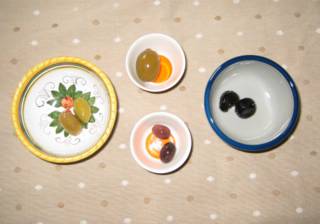
My grocery store has an olive bar, so I decided that this would be a good way to sample several varieties without spending too much. Many of the olives at the olive bar were unnamed large green olives with various stuffings, others were labeled “assorted”, and unfortunately quite a few had no label at all. I picked out a small selection – I went for the ones that had a specific name and then picked one of the stuffed ones as well. I ended up with Niçoise, Picholine, Moroccan oil-cured, and one stuffed with sun-dried tomato. I had a total of 8 olives and they cost me a whopping 24 cents!

When I got home, I poured myself a glass of wine, grabbed a big glass of ice water, and began my taste test. Obviously the most noticeable thing about olives is that they are salty. In fact, to my unpracticed palate they are so salty that it is difficult to differentiate one from another by taste. The two characteristics that I could distinguish were the degree of saltiness and the texture. The Moroccan oil-cured olive was very soft and incredibly salty – pretty awful. The Niçoise and Picholine olives were similar to each other in saltiness, but the Picholine olive was much firmer than the Niçoise. The large stuffed olive was somewhere between the Niçoise and Picholine in texture, but similar to both in saltiness. I preferred the Niçoise and Picholine olives over the others.

After I finished eating the olives, I read a little about them. I found out Moroccan oil-cured olives are considered bitter and better for cooking then snacking. Maybe I should have done a little research before I went to the olive bar!

The olive bar is nice in that it allows you to buy a selection of different olives at low cost and, if desired, in small quantities, but the downside is that you know very little about what you’re getting. So now they question is, am I ready to commit to a whole jar of olives? Guess I could always put them out for company…


left - Picholine, top middle - stuffed, bottom middle - niçoise, right - Moroccan oil-cured